

The fight to improve transit in Manitoba starts here!
Public transit in Manitoba is weakened and underfunded, because of cuts under the previous government. Now, Premier Wab Kinew has an opportunity and responsibility to keep his promise and restore matching provincial transit funding to municipalities, which would improve service.

Exporting LNG through the Port of Churchill
If Manitoba builds an LNG export terminal, most of the emissions from extracting, shipping, and burning fossil gas would not show up in it’s greenhouse gas emissions inventory. But the province would be directly complicit in facilitating the increased production, transportation and consumption of large volumes of fossil gas, further escalating global climate risks of catastrophic drought, wildfires, and flooding.

Chasing the Wind: The Rise, Stall, and Return of Wind Power in Manitoba
A path to the future for Manitoba’s wind power development.
This report explores the historical development of wind power in Manitoba from the early 2000s to the present to provide greater context for Manitoba Hydro’s current wind power procurement.

The Immense Potential of Wind, Solar, and Storage in Manitoba
The Challenge of Meeting Manitoba’s Growing Electricity Demand
This report argues that there are viable and reliable alternatives to addressing peak demand. Specifically, it describes the benefits of building wind and solar combined with energy storage, especially grid-scale batteries.
Manitoba’s
Road to Resilience
Manitoba can meet the goals set out in the IPCC’s 1.5 report. We have a community climate plan to do it.
Manitoba’s Road to Resilience is a series of reports that outline an achievable and concrete pathway to a climate resilient future, while considering human and economic impacts. The series lays out what is needed in order for us to feed, shelter, and transport Manitobans without the use of fossil fuels.
Reports in the series include:
– Volume 1: Community Pathway
– Volume 2: Energy Solutions
– Volume 3: Policy Solutions
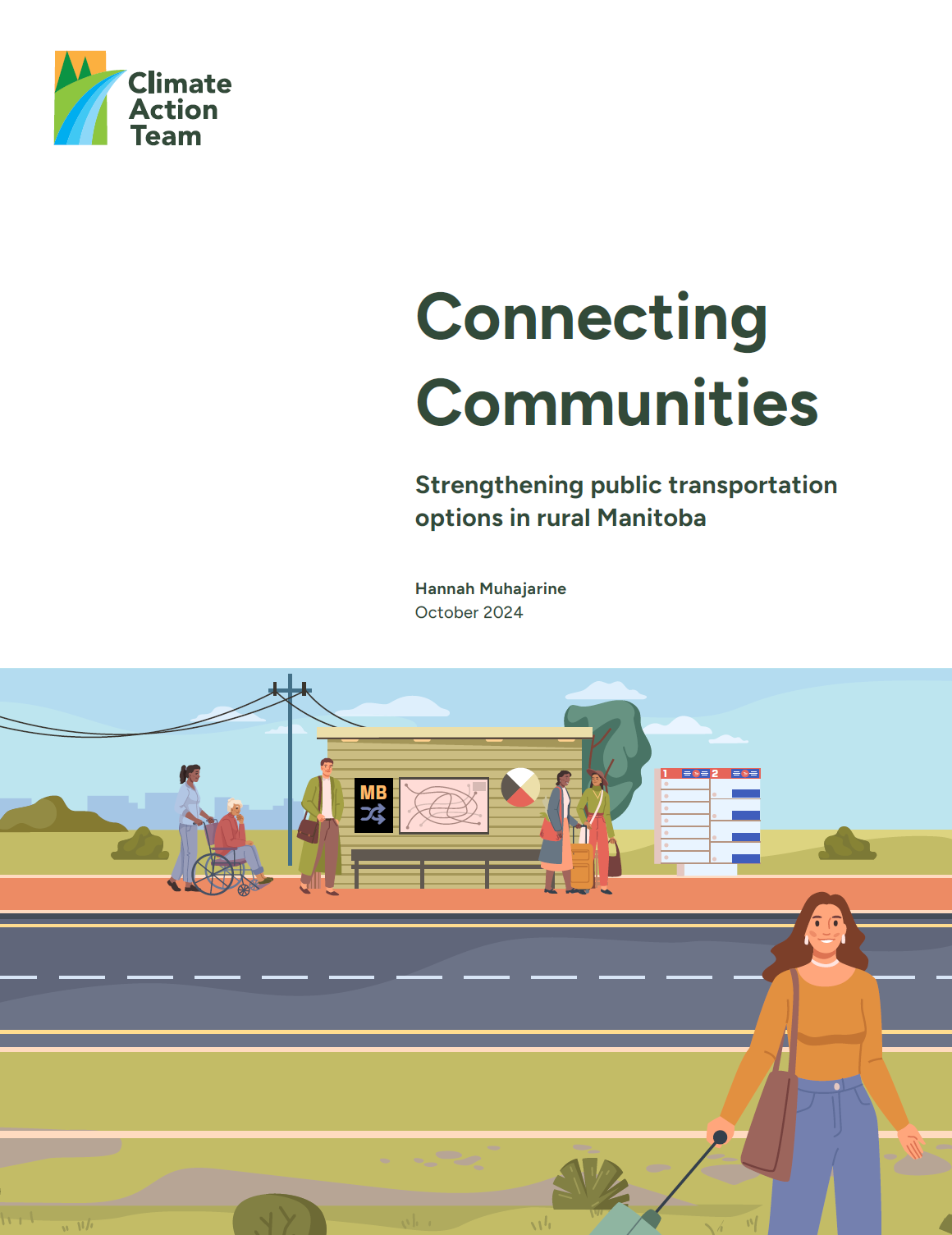
Connecting Communities
We’re advocating for improved rural, public transportation in Manitoba
Rural communities in Manitoba face significant transportation challenges, relying heavily on personal vehicles and friends for rides. This hinders medical care, economic growth, and community development. While some municipalities offer handi-van services for seniors and those with mobility needs, other groups, like low-income individuals and youth, often lack support.

Who We Are
Manitoba’s Climate Action Team (CAT) is a coalition of environmental organizations in Manitoba working together to envision, investigate, and promote a road to climate resilience in our province. Member groups came together in late 2017 to independently review and consult with the public over the Province’s recently released Climate and Green Plan. CAT was formed one short year later when the Intergovernmental Panel for Climate Change (IPCC) 1.5 Report was released, stating how fast we need to drastically cut greenhouse gas emissions in order to prevent irreversible outcomes. This drove home the need for an intentional, collaborative, and grassroots effort to push toward the future that we want.

A Resilient Future
To achieve a true and adequate resilience, Manitoba needs to focus on feeding ourselves, moving ourselves, and sheltering ourselves without the use of fossil fuels.

Transportation
We need to move all goods and people without gasoline or diesal

Food
We need to feed ourselves locally without fossil fuel fertilizers or diesel for machinery

Shelter
We need to heat all of our buildings (old and new) affordably without natural gas
The work of the Climate Action Team is made possible thanks to funding from The McConnell Foundation, The Trottier Family Foundation, The Winnipeg Foundation, and donors like you!


Our mission is to provide a framework for individuals, organizations, and communities to communicate and collaborate on a non-partisan, specific, and actionable path that will help Manitoba achieve resilience to climate impacts and move swiftly toward a fossil-fuel free future.